Saturday, February 18, 2023

Didn't we have a bunch of terrorist attacks? Shahbaz Sharif needs to call parliament and stop waiting on the PTI

The first sentence of this headline was originally written on 31 July 2020 during the hybrid regime/premiership of Imran Khan. It is being rescued and repurposed for current events.

Pakistan has faced a spate of terrorist attacks since last November when the Pakistan Army chief who held up the previous hybrid regime stepped down and the Pakistani Taliban restarted their campaign against this country. After the horrible bombing in Peshawar that killed a 101 people, 90% of them policemen on 30 January, the PML-N government wanted to call an all party conference.

The PTI, the previous government, did not respond and kept attacking the current PML-N government in the face of the horrific bombing that had happened and the calls for unity against the Pakistani Taliban. Imran Khan, the PTI’s leader’s, pro-Taliban rhetoric has been well known at this time, along with his unwavering characterisation of the PML-N which runs Pakistan now as thieves. Whatever. The Taliban are murderers. Basic morality would dictate uniting against murderers. But no. The PTI would not climb off its high horse over the mere issue of a 101 charred and crushed corpses of policemen in Peshawar. So here we are. There is no direction to Pakistan’s attempt to counter the TTP (Tehreek-e-Taliban Pakistan) campaign against it. The PTI would also not cooperate, because its actions, in welcoming the overthrow of the previous Afghan government next door, that had imprisoned the TTP members who had been captured in Afghanistan, and were now freed by the Taliban, to the crazy idea in which it resettled (!) those TTP members in the Khyber Pakhtunkhwa districts they had previously terrorised, had also contributed to the problem of the TTP’s resurgence.

In the face of the PTI’s intransigience, I think it is time that the PML-N government of Shahbaz Sharif make a move that strengthens democracy, rather than privatising it among an alliance of parties, and calls a session of parliament to discuss the issue of terrorism, the TTP’s resurgence and how to counter it. It would definitely be more democratic, clear the air as everyone gets to have their say and would be more within the ambit of the constitution than an “All Parties Conference.” There's something about not having this debate in parliament that strikes me as anti-democratic. I know also that Prime Minister Shahbaz Sharif is essentially a far-right man and strengthening democracy is never front and centre with his plans, but in the face of the pointlessness of engaging with those who ignore or make excuses for the Taliban like the PTI and its leader, and the resurgence of the TTP, we are left with no choice but to have parliament debate how to deal with these terrorists.

And hey – Ali Wazir’s free and he will get to have his say! I’m up for it.

Ali Wazir, MNA from South Waziristan and Pashtun Tahafuz Movement (PTM) leader, has been released from Karachi prison. PHOTO: TWITTER/@mjdawar

______________________________________________________________________________________

 If you like my work, please support it at https://www.patreon.com/TheseLongWars

Saturday, August 21, 2021

Pakistani views on the fall of Afghanistan to the Taliban

The world is surprised, and now even memeing, about the Taliban’s takeover in Afghanistan. In Pakistan, the outside country most responsible for this (unless you count America and the stupidity of its occupation strategies as the most responsible) there have been broadly three camps on this. The majority feeling was one of awkwardness, trepidation and a calling of the equivalent of councils of war. In the Army Chief’s staff rooms, in the Prime Minister’s and Chief Ministers and political party heads’ secretariats and across media stations in Pakistan, the national security and Afghanistan experts were on display and they were giving their council to their respective audiences on what was happening with the fall of Kabul and what it meant.
 
A smaller minority was one that was sometimes part of this but also openly condemning the takeover of the Taliban. Honourable mention should go to the Women’s Democratic Front for openly condemning the takeover of Afghanistan and various branches of Pakistan’s new-on-the-scene Aurat March (Women’s March) parroted their view. Frankly, I am very happy for the Aurat Marchers to get an explicit foreign policy – that would be cool. The PPP, as far as I can tell did not explicitly condemn the Taliban takeover in Kabul and as far as I know, no Pashtun nationalist formation did either, although if the Pashtun Tahaffuz Movement did, I am waiting for their views.
 
The official Pakistan government view, of the foreign ministry, the part allegedly controlled by Imran Khan says that they will not stick their neck out as an individual country and will only recognise Taliban control of Afghanistan if a group of countries, likely Russia, China and Iran, all simultaneously recognise the Taliban's control of Kabul. I used the word alleged, because the foreign ministry takes its marching orders from the Pakistan Army's General Hear Quarters, Imran Khan is fine with that, and so the foreign ministry's views are the Army and establishment's views. Honestly, the Taliban victory in Afghanistan feels like the logical end of the hybrid regime and a subsidiary or partial objective of the Pakistan Army engineering Imran Khan into office. It's like when Imran Khan became Prime Minister, one of the things the Army wanted was the Afghan Taliban taking over that country. Now these fools have to deal with the consequences of getting what they want.

Lastly, I have to mention the Taliban supporters. From heads of religious groups, to Taliban and ’80’s Afghan Mujahideen fanboys in the Pakistani media, this was, I feel, an even smaller group, restricted by age, that was openly hailing the takeover of Afghanistan by the Taliban. It really was/is a sight to behold to see men in the media, of or beyond retirement age, hailing the takeover of Afghanistan by the Taliban – a sick joke. My guess is younger fans of the Taliban were either intelligently hiding, or more likely taking part in either jihadi ops or doing propaganda or harassment for the Taliban. So the pro-Taliban crowd inside Pakistan might be quieter than its portrayed – a bit like Italy after it switched ides in WWII to join the Allies against Germany.

______________________________________________________________________________________

 If you like my work, please support it at https://www.patreon.com/TheseLongWars

Saturday, August 14, 2021

General Bajwa, please retire

This blog was previously published on 28 November 2019 and is being re-published, like many recovered blogposts, over here.

There has been a crisis of governance in Pakistan over the last few days as the Pakistan Tehreek-e-Insaaf (PTI) controlled government of Prime Minister Imran Khan has abandoned all its governance reponsibilities to try and get General Qamar Javed Bajwa, the Chief of Army Staff (COAS) an extension of three more years.

Now he is about to begin a period as Army Chief, beyond his entitlement. Unlike calling for his firing, like I did the last time a COAS got an extension, I will take a more measured approach to what should be done here. Let's look at the era that General Bajwa inhabited as the leader of Pakistan's 550,000 man army.

Since General Bajwa came to power in late November 2016, (coincidentially, after Donald Trump secured a victory in the 2016 US elections, distracting the US from political developments across the world) he has presided over, in the words of former columnist Cyril Almeida, "the greatest rollback of civil liberties, political rights and media freedom in a generation."

More dissident parts of the media came under active surveillance, Pakistani Facebook bloggers were picked up with accusations of first blasphemy, then switching to allegations of personal corruption, and the PML-N's political activists (and those of other non military allied political formations) were pursued and locked up with a vengeance throughout 2017.

The Prime Minister at that time, Nawaz Sharif, of the Pakistan Muslim League-Nawaz (PML-N), was under a serious cloud of scandal from his relation to the Pakistan section of the Panama Paper leaks. This had emboldened the reactionary right wing under Imran Khan and his PTI party as well as other the reactionary segments of the political opposition, the media, and much of the army which was not happy with him due to his consolidating position as Prime Minister and pursued a whisper campaign against him as a tainted friend of Pakistan's rival, India.

This all came to a head with Prime Minister Nawaz Sharif's removal from power in July 2017 and his succession by the hapless Shahid Khaqan Abbasi as Pakistan's new Prime Minister.

This win for the military and reactionary nationalist segments of the state are consolidated by the months long crisis that happens in Pakistan at the hands of the extremists of the Tehreek-e-Labbaik Ya Rasollullah (TLYRA) .

Abbasi's months old government is then hounded by sit-ins in the capital by the sectarian extremists of the TLYRA who created such an air of fanaticism that a PML-N minister, Ahsan Iqbal was shot at and nearly died.

With the government on the ropes, the country went into an election in 2018 that was charged with mounting repression of the media by the state, of the political government's party members or their allied groups coming under mounting threats and oppression and a society that was being repressed by anti-blasphemy paranoia, turbo charged by roaming fanatics who claimed to be partisans of the Prophet of Islam, in an anti-Ahmedi sort of way that cut into the PML-N's own anti-Ahmedi, pro-blasphemy votebank.

So the election of July 2018 happens and the margin of difference between the PTI and the PML-N is the approximately 4 million votes half of which go to the TLYRA's political formation, the TLP. Clearly, Imran Khan's two decades of political demonisation of the not very above board PML-N and PPP has paid off and now Mr Imran Khan is Pakistan's Prime Minister.

The banned cover of Sohail Warraich's 2010 book “Yay Company Nahi Chalay Gi” (This Company Will Not Run) all copies of which were confiscated from its publisher in Lahore.

As his governance begins, the abysmal and darkly comic performance of his government at the federal centre of Pakistan lay bare the Prime Minister's incompetence and ignorance of governance. There is a balance of payment crisis and the government mis-judges India's mood as friendly, when the newly re-elected Narendra Modi government clamps down on Kashmir instead of opening up with it's fellow religio-nationalist reactionaries across the border. Active moves to suppress the opposition and the media continue from 2018 into 2019. It is small wonder that this political government has been called a hybrid regime and seen as being hand-in-glove with the Pakistan Army.

All this time, General Bajwa stood in the background, the shady shogun of a reactionary nationalist, allegedly democratic dispensation. Unlike previous Army Chiefs this century, such as Generals Raheel Sharif, Ashfaq Pervez Kayani and Pervez Musharraf, there is very little critique published in regards to him.

Since I've read very few printed critiques of General Bajwa I had only a basic frame with which to describe him. It made writing this blog feel a little strange. Like flexing a numb hand.

However, watching events this week, an old quote from General Musharraf's decade-long dictatorship came to mind: the graveyards are full of indispensible men.

Imran Khan's government granted General Bajwa an extension in August 2019. However, when it was challenged this week in the Supreme Court, the retiring Chief Justice decided to take up the petition on a suo motu basis and simply questioned the legality of the extension. When it came up that the extension had no basis in the law, the reactionary nationalist PTI moved to quickly change the law. This lead to the situation we are in now, where the decision to extend an Army Chief's tenure has now been kicked into parliament.

For one military bureaucrat, the Army Chief, the entire federal machinery of Pakistan has ground to a halt to shamelessly grant him an extension as the chief. This is embarrassing for this country.

The PTI government will remain a shambolic mess. And if General Qamar Javed Bajwa extends his tenure, then his name will be etched with this slow moving disaster. However, the General remains a military man, and there is an honourable way for him to write his name in this country's history. In my retelling of the PML-N government's fall and the PTI government's rise General Bajwa only remains a grey eminence. If he takes this extension and decides to continue to be the military support beam for this chaos Imran Khan and his acolytes call governance, then his name will be forever attached to this disaster.

There is an honourable way out of this, an easy opportunity to still take the ride into the sunset, that General Bajwa's age and bureaucratic convention entitle him to. Retire. Take the way out. Leave this overgrown teenager who you have foisted on this country, grow up and take the responsibility that he has been howling for.

And don't be the fall guy for an institute that you served but harboured the snakes who tried to have you condemned for sectarian reasons. I did not mention this earlier, but I think it bears mentioning that the Ahmadi sect is considered heretical by a dangerously large number of Pakistanis who consider themselves devout. When General Bajwa became Chief of the Army in November 2016 he was dogged by rumours of either being an Ahmedi or being related to them, in a country that is dangerous for Ahmedis. This is dangerous in Pakistan, and the vectors of this sectarian rumour mongering was alleged to be from the army or the more anti-Ahmedi parts of then Prime Minister Nawaz Sharif's PML-N party. This was a poisonous start to what should have been a relatively smooth transition of power from the tough-against-terrorism General Raheel Sharif to a successor who would be leading an army in a relatively less violent Pakistan.

Now however General Bajwa is powerful. But he will not be so forever. The PTI, can falter. And as a man explicitly soon tied to this party and his votebank for a further three years, General Bajwa will be dragged from a grey eminence into an exposed support beam for this government. Bajwa can contemplate the position of General Kayani, and how he became inextricably linked to the disasters of President Zardari's government, how much of a cleanser it felt when in 2013, General Raheel Sharif, brother to one martyr, nephew to another, bought a fully martial bearing on an army that had to fight the Taliban in North Waziristan and chase them out of the rest of the country. General Bajwa can also remember what a sheepish figure the retired Kayani looked like in his sherwani at one of the military parades held under General Raheel.  Pakistan can do without all this neo-Shogunism. Being an Islamic shogunate is tiresome for a country and a people.

If this is not enough, General Bajwa can contemplate the snakes, the poisonous snakes in civil politics and in his own army. And then he can think about a future where these creeps aren't his problem. Simultaneously, General Bajwa doesn't have to end up like Kayani. There's still time. General sahab can still buy the ticket, take the ride and GTFO from the disaster that is Pakistani politics. The rest of us still have to live here.

Please retire.

__________________________________________________________

If you like my work, please support it at https://www.patreon.com/TheseLongWars

Friday, August 13, 2021

30 days? That's an excuse to run consulate shredders — Kabul’s government won’t last the week

I started yesterday with a news article about how US intelligence said that the Taliban could take Kabul in 90 days. After the previous week had been filled with over half a dozen Afghan provincial capitals falling, it became clear that the Taliban were deploying all their strength across the country to capture as much territory and control as they could before US forces pulled out before the 20th anniversary of the September 11th attacks.

While the news of those northern cities falling had been bad, and it was felt that the Taliban were likely trying to prevent a replay of the 1990's Afghan civil war when the north fought them for five years, 12th August got progressively grim. It started to seem that the Taliban were not just going to put a knife to the Afghan government's throat (and northern escape routes) by taking Tajik and Uzbek cities, but rather box Kabul in. This became clear when not just small towns but larger Afghan cities were put on the chopping block by the Taliban's offensive. There is a wave of anti-Shia mobilisation across the region and I suspect that it also might have something to do with the expanded, multi-ethnic Taliban mobilisation in the north of Afghanistan. As these provinces border the ex-Soviet Central Asian states, and ISIS school-shooter sectarianism has had salience in many places where Muslims were previously considered un-radicalised or nominally secular, I suspect Taliban lines might not be a bad place for Central Asian, Afghan or even Pakistani potential ISIS recruits to flee.

As news of more fighting came in, the reports of Herat and Kandahar in the north-west and south of the country respectively, being surrounded and attacked threw whatever strategic calculus the great powers thought they had in Afghanistan, into the bin.

The updates from panicked civilians about the Taliban attacks killed whatever illusions about America having a semi-peaceful withdrawal from Afghanistan, or Pakistan smoothly sliding a re-furbished Taliban into power in Kabul, might have been harboured by the countries that have sponsored destructive wars in that nation since the eighties. The distressed calls, postings, video reports of Afghan citizens, especially educated women trapped in these cities, came flooding out. No one was crying but everyone was deadly serious. 

Simultaneously, clips of refugees flooding out of captured cities, camps of the displaced going up in Kabul and where the government stood were broadcast. Among the wretched sights was the Afghan military vehicles zooming out of cities and from among people they were supposed to defend were broadcast as afternoon turned to evening, and then night fell.

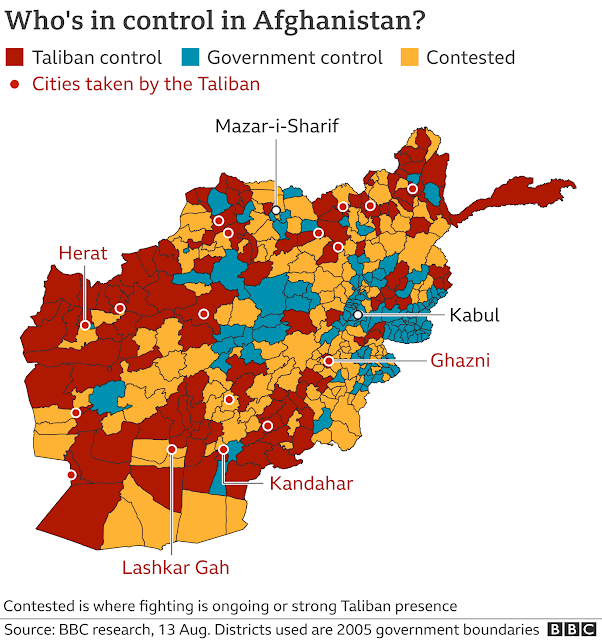
The west, south and north of Afghanistan are out of that government's hand. Kabul is boxed in. If you look at the map above, it's sitting in the open jaws of Taliban controlled territory.

The BBC generally has the best maps, and frankly the best and most accurate, un-sentimental coverage on the rout in Afghanistan of the Kabul government. Hey, I guess after four disastrous wars into a country, they end up knowing their stuff. The second best coverage is by Al Jazeera, which also sobered up once it stopped sourcing its maps from neo-conservative American outfits, and ditched a sort of mawkish patronising tone for the Afghans.

As for America's intelligence reports, which we started Thursday with - they have achieved the typical notoriety of stupidity that American intelligence reports are known for. By nightfall, the American bureaucrats had, in typical CYA fashion, re-assessed their estimate down to 30 days. That feels optimistic.

As reports come in of Afghan business interests trying to wrap up and send their equipment, personnel and capital out of the country, and the various state and private banks withdrawing funds to forward abroad, it becomes clear that the Kabul government, especially the career of one President Ashraf Ghani, is very over. At least at the prospect of anything beyond 2021.

What happens to the rest of the Kabul government is anyone's guess. I don't know if the Taliban have much to worry about "holding" their territory if part of their offensive was contacting Afghan defence forces commanders and asking them to stop fighting/withdraw or switch sides. A government counter-offensive seems highly unlikely, especially with the hollow, broken Afghan Army that has been described. If the Taliban went in for the kill against the government, then they would win and also be saddled with a lot of prisoners, many extremely high value ones as well as seas of refugees and an isolated country. I suspect they might be willing to live with that. 

How soon will the end happen? The fall of Kabul, the closing of the Taliban's jaws on what is left of Afghanistan's government, that is now in the Taliban's hands.

__________________________________________________________

If you like my work, please support it at https://www.patreon.com/TheseLongWars

Thursday, October 15, 2020

Twin bombings across Pakistan in Waziristan and Ormara

I'm going to link to the Dawn article, because let's face it, nobody except state apparatuses are now reporting on Balochistan, because all independent media worth mentioning has been forced out by violence and intimidation. The Balochistan model of political control is being rolled out across Pakistan with varying degrees of political success.

I don't know what I can say about the Waziristan attacks, besides maybe the state of Pakistan should stop using the former FATA districts as a launching ground for attacks into Afghanistan. That sort of observation feels redundant, but one would imagine that the milieu that feeds extremists and makes it easier for them to thrive there might also succour anti-state extremists.

What I can say about the Balochistan attacks besides that I think enough is enough with using the Frontier Corps (FC) for internal security. Up-arm and up-armour the Balochistan police and send them after the insurgents. That can be done if we give the Baloch people a stake in their future by creating as many jobs as there are households in Balochistan. The number of non-secessionist Baloch probably outnumbers the number of secessionists. However, their interest in breaking away would be neither here nor there if there were serious economic reasons for them to remain tied to Pakistan and the state did not predate on their resources. If Balochistan was treated as a normal province rather than a colony, enough residents would take care of the violent secessionists on their own. I think this insurgency, and over-extended internal security mission in Balochistan has gone on long enough. This is supposed to be the Fifth Baloch insurgency, and I'm not even sure if we are in the fifth or sixth phase of this Fifth Baloch insurgency.

I'm gonna have to lean on NFP's views on how these conflicts in these socially marginal districts are now being fed and politicised by the larger mainstream, ultra-nationalistic polarisation.

You can read Dawn's report on the attacks, here

Ayesha Siddiqa's succint history of anti-Shia Deobandis

Ayesha Siddiqa covered the sudden rise of anti-Shia extremism in Pakistan, in a recent article. In it she gave a short history on the provenance of anti-Shia, Sunni extremism in the country that's worth reading:

Though the first instance of Sunni-Shia tension erupted around 1951 in Sindh, it built up more decisively during the 1980s. General Zia-ul-Haq’s regime looked away while the Anjuman-e-Sipah-e-Sahaba (ASS) took birth in Jhang, South Punjab in 1986. It later turned into the Sipah-e-Sahaba Pakistan (SSP) that became the mothership of all Deobandi militancy. It gave birth to Lashkar-e-Jhangvi (LeJ) during the early 1990s, and also the Harkat-ul-Mujahideen, Harkat-ul-Ansar, and later Jaish-e-Mohammed (JeM).

During counter-terrorism operations by Pakistan, segments from the SSP, LeJ and JeM went into making the Tehreek-e-Taliban Pakistan (TTP). Some members of this even went on to join Daesh. The SSP was also one of the first organisations to fight in Afghanistan. Besides militancy, the organisation also engaged in politics. Its leader, Haq Nawaz Jhangvi, initially contested elections in 1988 from a Jamiat-e-Ulema-e-Islam–Fazlur Rehman (JUI-F) ticket, and later formed his own party. Around the time Haq was killed in 1990 outside Islamabad, Pakistan saw a lot of bloodshed, including sectarian violence, through the decade of the 1980s, 1990s, and the 2000s. Like the evolution of its militant wings, the SSP’s political face also evolved. One of its current forms is the group Ahle Sunnat-Wal-Jamaat (ASWJ), which is visible in electoral politics. The SSP and other militant groups are part of the Deobandi network that comprises militant outfits, political groups, and welfare institutions.

The network is so well spread out in the largest province of Punjab that there are over 20,000 staunch Deobandi voters in every constituency, which makes the group important for all political parties and builds their influence. The JUI-F, headed by Maulana Fazlur Rehman, is one of the most prominent faces of the network. It is instrumental in partnering with the Pakistan Peoples Party (PPP) and spreading the influence of Rehman’s network in Sindh and Baluchistan.

Below is an election poster of anti-Shia faces, with my opinion framing them.

Monday, September 14, 2020

Writing for Brown Pundits too!

This makes it official — I've joined BrownPundits.com and I'm writing there as well. I'm quite happy that I was asked to join up with them, and will also be cross-posting there too. This blog needs some updates, and writing for another website will motivate me to write regularly. For now, I'll cross-post the intro I wrote on their website. I guess all I can say is:

Hello Nurse!